This is a Sonnet 3.6 translation of a Chinese article. Please be mindful of potential translation errors.
Last time we introduced how rank0 machine generated ncclUniqueId and completed the initialization of machine’s bootstrap network and communication network. This section continues to look at how bootstrap connections between all nodes are established.
Rank0 node executes ncclGetUniqueId to generate ncclUniqueId, broadcasts the Id to all nodes via mpi, then all nodes will execute ncclCommInitRank. Here other nodes will also initialize bootstrap network and communication network operations, then execute ncclCommInitRankSync
ncclComm_t is a pointer to ncclComm. ncclComm is a mixture containing all context information used for communication. Its fields will be introduced when used. Then newcom is allocated through commAlloc and initialized, such as which card it currently is, what the corresponding pcie busid is, then execute initTransportsRank
ncclResult_tbootstrapInit(ncclUniqueId*id,intrank,intnranks,void**commState){ncclNetHandle_t*netHandle=(ncclNetHandle_t*)id;boolidFromEnv=getenv("NCCL_COMM_ID")!=NULL;structextState*state;NCCLCHECK(ncclCalloc(&state,1));state->rank=rank;state->nranks=nranks;*commState=state;TRACE(NCCL_INIT,"rank %d nranks %d",rank,nranks);structextInfoinfo={0};info.rank=rank;info.nranks=nranks;void*tmpSendComm,*tmpRecvComm;// Pass the remote address to listen via info
if(idFromEnv){memcpy(&info.extHandleListen,netHandle,sizeof(ncclNetHandle_t));memcpy(&info.extHandleListenRoot,netHandle,sizeof(ncclNetHandle_t));}// listen will return the local address via info (specify interface type 'findSubnetIf')
state->dev=idFromEnv?findSubnetIf:0;void*extBstrapListenCommRoot;NCCLCHECK(bootstrapNetListen(state->dev,&info.extHandleListen,&state->extBstrapListenComm));NCCLCHECK(bootstrapNetListen(state->dev,&info.extHandleListenRoot,&extBstrapListenCommRoot));// stagger connection times to avoid an overload of the root at very high rank counts
if(nranks>128){longmsec=rank;structtimespectv;tv.tv_sec=msec/1000;tv.tv_nsec=1000000*(msec%1000);TRACE(NCCL_INIT,"rank %d delaying connection to root by %ld msec",rank,msec);(void)nanosleep(&tv,NULL);}// send info on my listening socket to root
NCCLCHECK(bootstrapNetConnect(state->dev,netHandle,&tmpSendComm));NCCLCHECK(bootstrapNetSend(tmpSendComm,&info,sizeof(info)));NCCLCHECK(bootstrapNetCloseSend(tmpSendComm));// get info on my "next" rank in the bootstrap ring from root
}
First look at commState, which is the bootstrap of ncclComm, type is extState
Where extBstrapRingSendComm is the socket connection between current node and next, extBstrapRingRecvComm is the socket connection between current node and prev node, extBstrapListenComm is the listening socket of current node, peerBstrapHandles are the ip ports of all ranks (corresponding to extBstrapListenComm), dev defaults to 0, indicating which ip address to use
Then create extHandleListen and extHandleListenRoot two bootstrap comms through bootstrapNetListen. As mentioned earlier, bootstrap comm is actually just saving fd. The reason for creating two comms here is that extHandleListen is the actual bootstrap connection used between ranks, extHandleListenRoot is the connection used for communication between rank0 node and all other ranks
The bootstrapNetListen function was introduced in the last section. It will get the ip of the current machine for the dev-th device, then listen to get the listening fd, write ip port to nethandle, and write the obtained bootstrap comm to listencomm
Then write rank, nrank, extHandleListen and extHandleListenRoot to extInfo
netHandle is ncclUniqueId, which is rank0’s ip port, then create bootstrap send comm through bootstrapNetConnect. Comparing to bootstrapNetListen, bootstrapNetConnect establishes socket connection to netHandle and writes socket to sendComm. The dev is not used here
Where socketSend executes the send interface to send data
Then close fd through bootstrapNetCloseSend
What will rank0 do after receiving the data? Recall that rank0’s node executes ncclGetUniqueId to generate ncclUniqueId, and at the end of executing bootstrapCreateRoot, it will start a thread to execute bootstrapRoot
staticvoid*bootstrapRoot(void*listenComm){structextInfoinfo;ncclNetHandle_t*rankHandles=NULL;ncclNetHandle_t*rankHandlesRoot=NULL;// for initial rank <-> root information exchange
ncclNetHandle_tzero={0};// for sanity checking
void*tmpComm;ncclResult_tres;setFilesLimit();TRACE(NCCL_INIT,"BEGIN");/* Receive addresses from all ranks */intnranks=0,c=0;do{NCCLCHECKGOTO(bootstrapNetAccept(listenComm,&tmpComm),res,out);NCCLCHECKGOTO(bootstrapNetRecv(tmpComm,&info,sizeof(info)),res,out);NCCLCHECKGOTO(bootstrapNetCloseRecv(tmpComm),res,out);if(c==0){nranks=info.nranks;NCCLCHECKGOTO(ncclCalloc(&rankHandles,nranks),res,out);NCCLCHECKGOTO(ncclCalloc(&rankHandlesRoot,nranks),res,out);}if(nranks!=info.nranks){WARN("Bootstrap Root : mismatch in rank count from procs %d : %d",nranks,info.nranks);gotoout;}if(memcmp(&zero,&rankHandlesRoot[info.rank],sizeof(ncclNetHandle_t))!=0){WARN("Bootstrap Root : rank %d of %d ranks has already checked in",info.rank,nranks);gotoout;}// Save the connection handle for that rank
memcpy(rankHandlesRoot+info.rank,info.extHandleListenRoot,sizeof(ncclNetHandle_t));memcpy(rankHandles+info.rank,info.extHandleListen,sizeof(ncclNetHandle_t));++c;TRACE(NCCL_INIT,"Received connect from rank %d total %d/%d",info.rank,c,nranks);}while(c<nranks);TRACE(NCCL_INIT,"COLLECTED ALL %d HANDLES",nranks);// Send the connect handle for the next rank in the AllGather ring
for(intr=0;r<nranks;++r){intnext=(r+1)%nranks;void*tmpSendComm;NCCLCHECKGOTO(bootstrapNetConnect(0,rankHandlesRoot+r,&tmpSendComm),res,out);NCCLCHECKGOTO(bootstrapNetSend(tmpSendComm,rankHandles+next,sizeof(ncclNetHandle_t)),res,out);NCCLCHECKGOTO(bootstrapNetCloseSend(tmpSendComm),res,out);}TRACE(NCCL_INIT,"SENT OUT ALL %d HANDLES",nranks);out:bootstrapNetCloseListen(listenComm);if(rankHandles)free(rankHandles);if(rankHandlesRoot)free(rankHandlesRoot);TRACE(NCCL_INIT,"DONE");returnNULL;}
listenComm is the listening fd created by rank0 in the previous blog post. bootstrapNetAccept gets a new connection from listenComm and creates recvcomm using the new connection’s fd
Then read tmpComm’s data through bootstrapNetRecv, which is the extInfo sent by other ranks, and save other ranks’ extHandleListen and extHandleListenRoot. At this point rank0 has obtained the ip and port of all other ranks. After getting all ranks’ info, start building the ring by sending node (r+1) % nranks’s extHandleListen to node r, meaning sending node r’s next node’s nethandle to node r. Here we can see that each node created two listen comms, where rank0 communicates using extHandleListenRoot, and other nodes communicate with each other through extHandleListen
ncclResult_tbootstrapInit(ncclUniqueId*id,intrank,intnranks,void**commState){// get info on my "next" rank in the bootstrap ring from root
ncclNetHandle_textHandleNext;NCCLCHECK(bootstrapNetAccept(extBstrapListenCommRoot,&tmpRecvComm));NCCLCHECK(bootstrapNetRecv(tmpRecvComm,&extHandleNext,sizeof(extHandleNext)));NCCLCHECK(bootstrapNetCloseRecv(tmpRecvComm));NCCLCHECK(bootstrapNetCloseListen(extBstrapListenCommRoot));NCCLCHECK(bootstrapNetConnect(state->dev,&extHandleNext,&state->extBstrapRingSendComm));// Accept the connect request from the previous rank in the AllGather ring
NCCLCHECK(bootstrapNetAccept(state->extBstrapListenComm,&state->extBstrapRingRecvComm));// AllGather all listen handlers
NCCLCHECK(ncclCalloc(&state->peerBstrapHandles,nranks));memcpy(state->peerBstrapHandles+rank,info.extHandleListen,sizeof(ncclNetHandle_t));NCCLCHECK(bootstrapAllGather(state,state->peerBstrapHandles,sizeof(ncclNetHandle_t)));TRACE(NCCL_INIT,"rank %d nranks %d - DONE",rank,nranks);returnncclSuccess;}
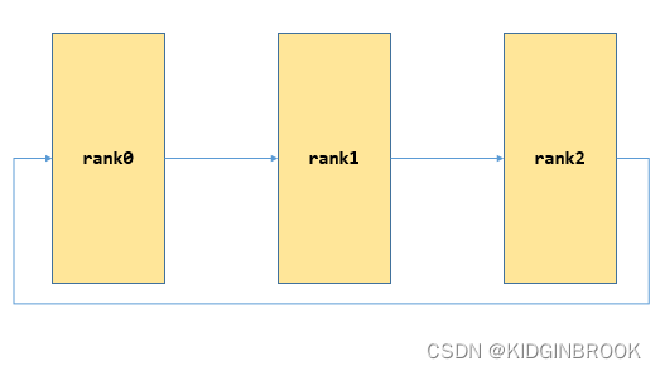
Then all ranks will receive new connections on extHandleListenRoot to create tmpRecvComm, then receive the current rank’s next ip, port; then connect next to create bscomm to state->extBstrapRingSendComm, receive prev’s connection to create bscomm to state->extBstrapRingRecvComm. Now the bootstrap network connection is fully established, as shown below
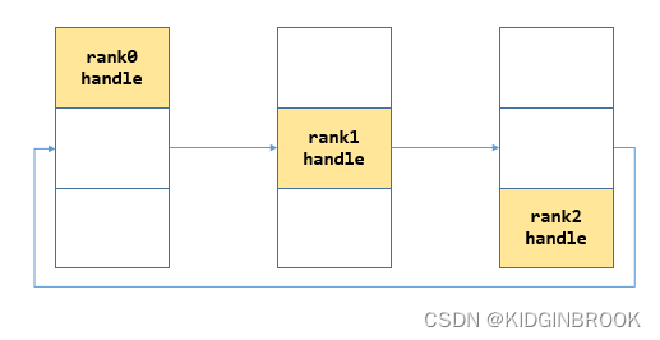
Finally gather all ranks’ ip ports, first put own nethandle to the corresponding position in peerBstrapHandles, as shown below
ncclResult_tbootstrapAllGather(void*commState,void*allData,intsize){structextState*state=(structextState*)commState;char*data=(char*)allData;intrank=state->rank;intnranks=state->nranks;TRACE(NCCL_INIT,"rank %d nranks %d size %d",rank,nranks,size);/* Simple ring based AllGather
* At each step i receive data from (rank-i-1) from left
* and send previous step's data from (rank-i) to right
*/for(inti=0;i<nranks-1;i++){size_trslice=(rank-i-1+nranks)%nranks;size_tsslice=(rank-i+nranks)%nranks;// Send slice to the right
NCCLCHECK(bootstrapNetSend(state->extBstrapRingSendComm,data+sslice*size,size));// Recv slice from the left
NCCLCHECK(bootstrapNetRecv(state->extBstrapRingRecvComm,data+rslice*size,size));}TRACE(NCCL_INIT,"rank %d nranks %d size %d - DONE",rank,nranks,size);returnncclSuccess;}
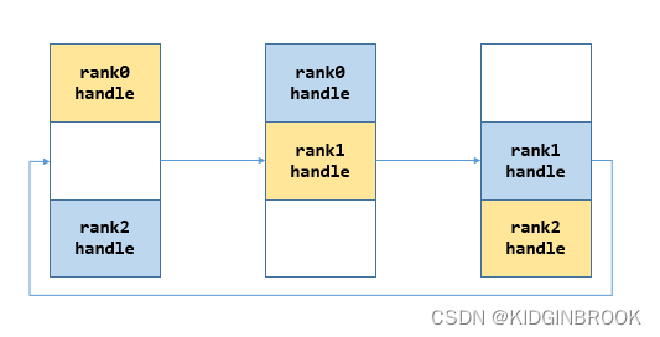
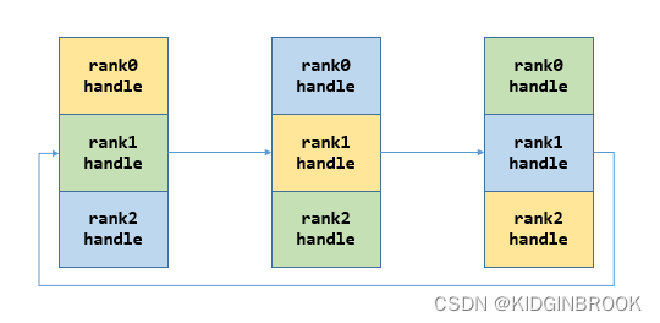
Each time send own data to corresponding rank, then receive data sent from other ranks, as shown below
Step 1:
Step 2:
At this point each rank has the global ip ports of all ranks
Finally to summarize, this section mainly created the bootstrap ring network connection and saved it to ncclComm.
NCCL Source Code Study - This article is part of a series.